

Author: Niomi Anna Cherney
Guest Author for November that hosts international Day of Solidarity with the Palestinian People
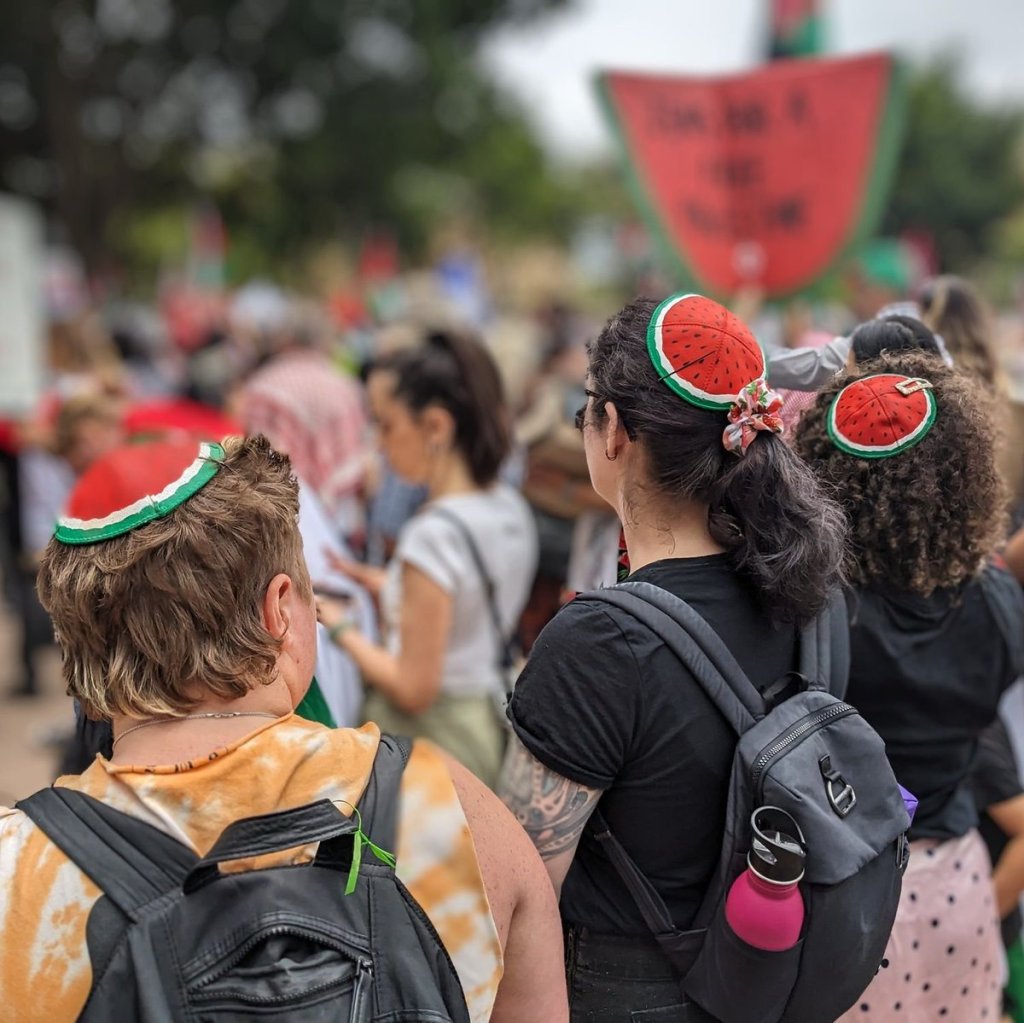
I identify as an Anti-Zionist Jew. I’ve held anti-Israel politics for as long as I have been reading Angela Davis, which is to say, perhaps 20 years. I used to throw out vague qualifiers such as “progressive” or “left wing” – that is, until Oct 7. Those qualifiers now feel like a cop out. I have learned that being a so-called progressive Jew isn’t synonymous with even a straightforward belief that Palestinians have a right to exist. Despite a loose left wing social equality lens, anti-Palestinian racism remains unchallenged in these circles. My clear stance as an anti-Zionist Jew has separated me, like many of my friends and colleagues, from my family and from my community. The stakes have become too high though and I cannot take a seat at a “progressive” Jewish table that is complicit in genocide. I remain, even in my anti-Zionism, a religiously observant Jew. Which is to say, I wish to observe the customs and rituals that I have been practicing throughout my life cycle. Perhaps now, in these times, I need to call on a sense of meaning and higher power more than ever. Committing to practicing the religion therefore means I must make a conscious uncoupling of Jewish rituals from Zionism and its trappings.
We are heading out from a month of four important Jewish holidays. The Hebrew month of Tishrei coincided with October of this year. Rosh Hashana (Jewish New Year) fell on October 2, while Yom Kippur (the Day of Atonement) was over Thanksgiving weekend on October 13. The period in between these two holidays is known as the Days of Awe (yamim noraim) and it represents deep introspection and reflection on ways we have wronged others in the past year. Following those two holidays, there is Sukkot (Oct. 16 – 23), a harvest festival in which we build symbolic dwellings (sukkah) and invite others into them. Finally, we have Simchat Torah (Oct 25), literally the Day of Celebrating the Torah. Even in this brief overview we see themes of accountability, of admitting and atoning for harm done, and of inviting strangers to share our hospitality. One cannot ignore how the values embedded in this most important cycle of holidays calls Jews to awaken to the suffering of others, to extend a hand at the very least.
On Yom Kippur, we ask for forgiveness in the first person plural – “Indeed, we have sinned. We have betrayed. We have stolen.” That is to say, you include your own being in all the sins atoned for as if you have done every single one. When you move in prayer in this way, to pray on behalf of the collective and of your place in it, something also moves in you. With the Declaration of Independence in 1948, Israel stole more than 4 million acres of land from Palestinians. When we pray in the first person singular it means that I too am part of this harm and it is my responsibility to repair it.October 7th fell during the Days of Awe. During those 10 days, a person would strive to have their fate sealed by God in the Book of Life through repentance, prayer and good deeds. The narrative is thick and saturated with meaning. Meaning which, this year, has been violently and brutally distorted to under-score the importance of Jewish safety and the Palestinian threat thereof.
I found strength in this collective we: it brought into focus the relationship between history and present, between active violence and poisonous ideology. Right here, in the famous liturgy of the most important holiday of the Jewish year, I am called to renew my commitment to Palestinian liberation. To seal my fate for good, so to speak, I renew my commitment to making known that the actions of the State of Israel do not speak for all Jews. And I will be as “Jew-ish” as I want to be without pledging any allegiance to Zionist ideology.
After Yom Kippur, one historically emerges with a kind of “clean” feeling: fresh from reflection and repentance. This year, I felt anything but clean.
“In the Beginning” (Bereishit) is the first Torah portion of the annual cycle following Simchat Torah which fell on Oct 7, 2023. It is usually read with the joy and brightness of a new cycle. It also, however, contains darkness with the light. In closing, the lines of this song reverberate in my head and guide my actions going forward. This song is a cry, a wail, of reckoning and collective responsibility.
Indeed, what have we done?
God says this to Cain after he has murdered his brother, Abel:
“Meh asita
What have you done?”
“Kol d’mei achicha, tzo’akim elyai min ha’adamah
The voice of your brother’s blood cries out to me from the ground.
Ayeka
Where are You?”
Meh achicha
What have we done?
Aly Halpert, English translation from the Tanakh
 Sporas
Leave a comment